





A strong immune system is no coincidence - it is the result of a finely tuned interaction between body, mind, and life circumstances. At our practice for holistic medicine and prevention in Munich, we do not view the immune system in isolation but as a dynamic system that responds daily to internal and external influences.
Being ill is not necessarily a sign of a weakened immune system. On
the contrary, it shows that our defense system is actively working.
From a medical standpoint, two to three infections per year are
considered normal and reflect a functioning immune response.
Especially in the urban everyday life of a large city like Munich,
we are exposed daily to numerous germs, environmental stimuli, and
stress factors - whether on public transport, at work, or in social
settings. The fact that our immune system usually balances these
burdens unnoticed is a testament to its remarkable performance.
Our immune system is designed to restore health. Dangers in life -
even in a modern urban society - can never be completely avoided.
Air quality, noise, time pressure, or emotional stress are part of
everyday life for many people in Munich.
Nevertheless, our body has the ability to self-regulate. This
interaction creates what we refer to as the innate feeling of
health: a deep, often unconscious sense of stability and inner
balance.
Virtually all aspects of life affect our immune defenses directly or indirectly:
A health-conscious lifestyle - especially in the demanding daily life of a metropolis like Munich - is therefore one of the most important pillars for a stable immune system.
The pyramid developed by Dr. Peter Schleicher illustrates the key factors influencing our immune system:
In holistic medicine, we always consider these levels together - because the immune system follows the principle of harmony.
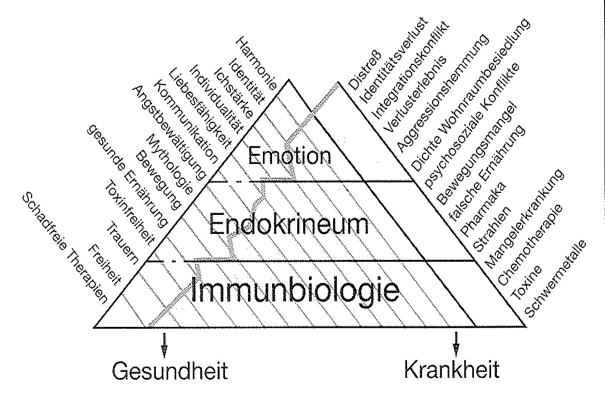
Our defense system doesn’t just react - it learns. It identifies
pathogens, stores information, and can respond more quickly and
precisely upon re-exposure. This immunological memory explains why
many infections become milder over a lifetime.
Even abnormal cells are recognized and eliminated daily by
specialized immune cells - so-called killer cells - often long
before they can cause harm.
Skin and mucous membranes form the first line of defense. Especially in areas with close contact to the external environment - respiratory tract, digestive system, skin - this barrier is of central importance.
This rapid response team reacts immediately to invaders. It works effectively but without specific memory. It includes, among others, phagocytes, monocytes, and natural killer cells.
Here, B and T lymphocytes come into play. They recognize specific pathogens, produce antibodies, and create an immunological memory - the foundation of long-term immunity.
White blood cells continuously circulate through the blood and
lymphatic systems. They are especially abundant in lymph nodes, the
spleen, intestines, lungs, and skin - areas where the body most
frequently encounters external influences.
This means: There is no place in the body left unprotected.
Stress, worries, and unresolved emotional conflicts directly affect
immune regulation. In modern preventive medicine, this connection -
also in our Munich practice - is gaining increasing importance.
Mindful self-care, emotional stability, and conscious regeneration
phases are therefore essential components of long-term immune
strengthening.
A healthy immune system is not the result of isolated measures, but
of a coherent overall concept that equally considers body, psyche,
and living environment. Prevention does not mean simplification or
shortcuts, but a deep understanding of biological interrelationships
and individual life circumstances.
Especially in today’s world - characterized by high work-related
stress, environmental factors, information overload, and emotional
strain - it is crucial not to view the immune system in isolation,
but as a regulatory whole that depends on harmony.
T lymphocytes make up the largest portion of lymphocytes and perform a wide range of tasks within the immune response. They play a major role in defending against fungal infections, viral infections, and tumor cells. Additionally, they are central to regulatory mechanisms that ensure immune reactions are targeted and not excessive.
The primary function of B lymphocytes is the production of immunoglobulins (antibodies). The production and release of these antibodies is the specific response to antigen contact. B lymphocytes also form so-called memory cells that can store an antigen for a lifetime. Upon renewed contact with the pathogen, appropriate antibodies can be produced within a short time.
Natural killer cells are part of the innate immune defense and can directly destroy virus-infected or abnormal cells through cell contact. They are not subject to classical antigen specificity and can act completely independently.
CD4+ helper T cells play a central role in coordinating the cellular immune response. They recognize antigens presented to them by antigen-presenting cells and then coordinate the activation of additional immune cells.
CD8+ T cells regulate immune responses and help control and harmonize the body’s defense reactions. They influence antibody production and regulate the interaction between helper T cells and B cells. For an effective immune response, a balanced ratio between CD4+ and CD8+ T cells is essential. The physiological ratio is approximately 1.3 ± 0.3.
The immune system is not an isolated organ but a highly complex,
adaptive regulatory system that responds daily to internal and
external stimuli. Its stability depends on biological precision,
emotional balance, and an individual’s life circumstances. Diseases
are not necessarily signs of weakness, but part of an active defense
and regeneration process.
A holistic medical perspective on the immune system therefore means
recognizing connections, assessing burdens, and specifically
strengthening individual resources.
If you have questions about your immune function or would like a medical assessment, we are happy to advise you personally at our practice in Munich.
01/22/2026